

If you run a General Practice, there’s a good chance a lot of your admin lives in one place: your head. Or the head of the one senior team member who has always just known how it’s done.
And that’s usually what stops the handover before it starts. “I’d love to hand that over, but I’d have to write it all down first.” So the manual goes on the list, the list gets longer, and the work stays exactly where it was.
Here’s some relief. Learning how to delegate admin tasks in a medical practice doesn’t need a manual first. It needs a few clear decisions, made one task at a time. Here’s a simple five-step way to do it.
Why “write the manual first” stalls so many handovers
A full procedure manual is a big, tiring job, and it’s rarely finished. Worse, it’s written before anyone has tried the task, so it’s full of guesses about what the person taking over will need to know.
Most of what a good handover needs is much smaller. It’s what the task is for, what “done properly” looks like, and where the awkward bits are. Everything else shows up quickly once the work starts.
Step 1: Pick one task and describe the outcome
Choose a single repeatable task, such as chasing overdue recalls or following up outstanding referrals. Before you explain how it’s done, write down in a few lines what a good result looks like.
For example: “Every patient overdue for a recall has been contacted within two working days, and the outcome is noted in their record.” That sentence does more work than a page of steps, because it tells the person what they’re aiming for.
Step 2: Show it once, out loud
Do the task as you normally would, and talk through it as you go. A short screen recording or a walk-through with a colleague is plenty. Don’t polish it. You’re capturing how you think about the task, including the small judgement calls you’ve stopped noticing.
This is the “manual”, and it takes twenty minutes instead of two weeks.
Step 3: Write one clear stop-and-ask rule
This is the step that protects patients, privacy and compliance, so it’s worth getting right. Decide what the person should do when something doesn’t fit the usual pattern, and make the answer simple: “If you’re not sure, stop and ask [name].”
A clear stop-and-ask line is far safer than hoping for good judgement. It also makes it easier for the person taking over to speak up early, which is what you want.
Step 4: Check the first few rounds closely
For the first week or two, look at the work more than you think you need to. Sample what’s been done, compare it to your “done properly” line, and give feedback straight away. Think of it as coaching rather than checking up on someone.
As the work settles into a rhythm, the checks can get lighter. That’s the point at which you’ll start to feel the time come back.
Step 5: Let the manual write itself
Every question that comes up in those first rounds is a gap worth capturing. Add it to a simple running note. After a few weeks you’ll have a short, accurate guide built from real situations in your Practice, not from guesses.
Two things worth keeping in mind
Start small. Three tasks is plenty for a first round. Pick ones that are repetitive, time-consuming and low in patient-facing risk, and let your team see the handover work before you add more.
Keep the accountability. Handing over the doing doesn’t mean handing over the ownership. You, or someone you name, still owns the outcome, and a short regular check keeps you close to it without having to do the work yourself.
If you’re still working out which tasks are the right ones to hand over, our post on Which admin tasks a General Practice can hand over, and which should stay is a good place to start.
Want to see the whole method?
We’ve built this into a free live session: Offload 130 Admin Tasks Without Losing Control of Your General Practice. It’s on Zoom, Wednesday 28 October at 10:00am AEDT (9:00am in Queensland).
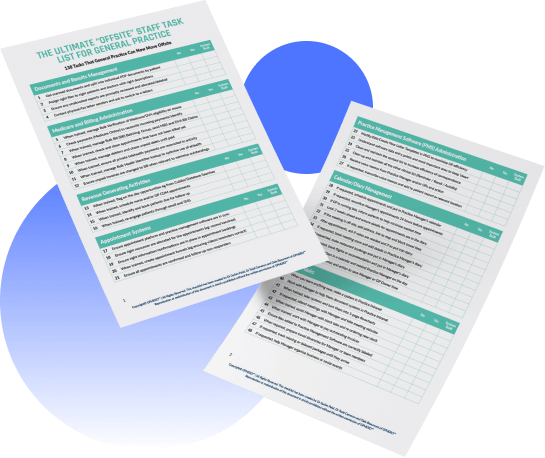
You’ll see the 130-task inventory sorted into what stays in-clinic and what can move, the handover method, the control checkpoints, and a way to choose your first three tasks.
Save your free seat → · Can’t make it live? Register anyway and we’ll send you the recording and the 130-Task Inventory.
You don’t need everything written down to begin. You only need to start with one task, and you already know your Practice well enough to do that.