If you run a General Practice, you probably already know the feeling. There’s a list of admin tasks that never quite gets finished, and a quieter worry sitting underneath it: if I hand this over, will it still be done properly?
That worry is sensible. It’s also the main reason capable Practice Managers keep carrying work they shouldn’t have to. Handing work over feels riskier than keeping it, even when keeping it is the thing wearing the team down.
So let’s make it less of a leap. Here’s a simple way to work out which admin tasks a General Practice can outsource, which should stay, and how to start without losing your grip on quality.
Step 1: Write down what your team actually did last week
Not the job descriptions. The real week. Recalls, referrals, results, inbox, phone messages, billing queries, Medicare claiming, document scanning, rebooking, chasing paperwork. Most Practices are surprised by how long the list gets once it’s all on one page, because so much of this work is invisible until it’s written down.
Step 2: Sort every task into three buckets
For each item, ask two questions: Does it need a clinician? and Does it need someone physically in the room?
Stays in the clinic. Anything clinical, anything that needs a person in front of the patient, and anything where the judgement call belongs to your doctors or your Practice Manager.
Can move offsite. Repeatable, process-driven work that follows the same steps each time: bookings and diary management, recalls and reminders, inbox triage, billing support, data entry, document handling and reporting.
Needs a closer look. Tasks that are mostly routine but have an edge case or two. These usually move later, once the simpler work has been handed over and you trust the rhythm.
In Practice, the admin tasks a General Practice can outsource are almost always the ones in that middle bucket. The point of the sorting isn’t to hand over as much as possible. It’s to be clear, task by task, about what is in and what is out.
Step 3: Check the control points before you hand anything over
This is the step that settles the nerves. Before a task moves, decide how you’ll keep hold of it:
- Who owns the outcome? It should still be you, or someone you name. Handing over the doing doesn’t mean handing over the accountability.
- What does “done properly” look like? Write it in a few lines. If you can’t describe it, it’s hard for anyone to do it the way you would.
- How will you see it? A short regular check, a simple report, a sample of completed work. Enough visibility that you’re never guessing.
- What’s the rule for the awkward cases? A clear “stop and ask” line protects patients, privacy and compliance far better than hoping for good judgement.
When these four are in place, a handover stops being a leap of faith and becomes a process you can see.
Step 4: Start with three tasks, not thirty
Pick three tasks from the “can move offsite” bucket. Choose ones that are repetitive, time-consuming and low in patient-facing risk. Hand those over first, check the work, and adjust.
A small start does two things. It proves the handover works in your Practice, with your systems and your standards. And it gives your team a good first experience, which makes the next handover much easier.
You don’t need a perfect manual before you begin, either. A handover method that doesn’t depend on a manual first means you can start with what’s in your head and refine as you go.
What this gives you back
The goal isn’t a cheaper version of the same Practice. It’s a calmer one. When the repeatable work moves offsite, your onsite team has room to be present for patients, your doctors get the support they’ve been asking for, and you get time for the things only a Practice Manager can do.
Want help sorting your own list?
We’ve put the sorting method into a free live session: Offload 130 Admin Tasks Without Losing Control of Your General Practice. It’s on Zoom, Wednesday 28 October at 10:00am AEDT (9:00am in Queensland).
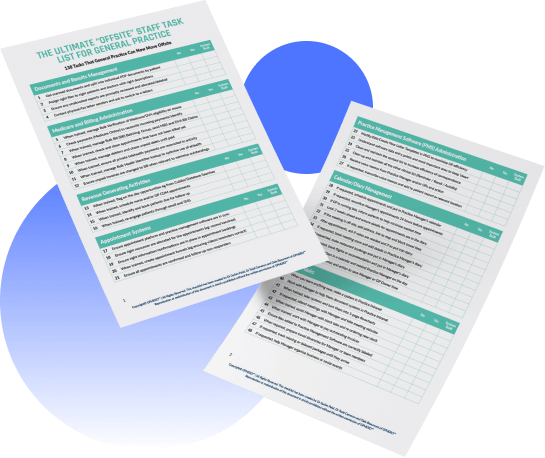
You’ll see the full 130-task inventory sorted into what stays and what can move, the handover method, the control checkpoints, and a way to choose your first three tasks.
Save your free seat → · Can’t make it live? Register anyway and we’ll send you the recording.
Handing work over isn’t giving up control. Done well, it’s how a good Practice Manager gets control back. You know your Practice better than anyone, and that’s exactly why this decision is yours to make well.