If you’ve typed “virtual assistant for doctors” into Google lately, you’re probably a Practice Manager or Practice Owner who has reached the point where the admin has outgrown the team. The phones, the inbox, the recalls, the billing that gets done at 9pm. You’re not after a gadget. You want to know whether a medical virtual assistant can really take some of it off your plate, without putting patients or privacy at risk.
Fair question. Here’s an honest answer.
What a medical virtual assistant does
A good medical virtual assistant takes the repetitive, time-eating admin that sits behind the front desk. In a General Practice, that usually means:
- Appointment bookings and diary management
- Inbox and email management
- Patient recalls and reminders
- Billing support
- Data entry, scanning and document handling
- Reporting and back-office workflows
None of this is glamorous, and all of it matters. It’s the work that quietly piles up on the same two or three people until someone burns out.
What they don’t do
Clarity is kinder than a vague promise, so here’s the boundary. A virtual assistant does nothing clinical, and nothing that needs someone physically in the room. Patients still get greeted by your onsite team. Your doctors still make every clinical call. The assistant works in the background so that your onsite team has more room to be present for the people in front of them.
Generic VA or one built for General Practice?
This is where most practices get stuck, because “virtual assistant” covers a lot of ground. A few questions help separate the two:
Do they know your software? A General Practice runs on specific systems, such as Best Practice. Someone who has to learn them from scratch on your time costs you more than they save.
Are they yours? A shared pool of assistants rotating across clients means you re-explain your processes every time. An assistant who is dedicated to your Practice learns how you work, and stays learned.
Is performance measured? Ask what service levels they commit to and how you’ll see them. If the answer is “we’ll check in now and then,” keep looking.
Do they understand General Practice privacy and security? If you’re a risk-sensitive owner, this is the question that matters most. You should be able to get clear answers on compliance, privacy and indemnity before anything starts, not after.
It’s a role question, not just a cost question
Most people start by comparing hourly rates. It’s a reasonable place to begin, but it can hide the bigger opportunity. The repeatable work (phones, bookings, billing, recalls, documents) can move offsite. That frees your onsite people to build the parts of the Practice only they can: doctor welfare, patient experience, and fixing the systems that keep tripping everyone up.
The goal isn’t a cheaper version of the same Practice. It’s a calmer, better one.
How to decide if it’s right for you
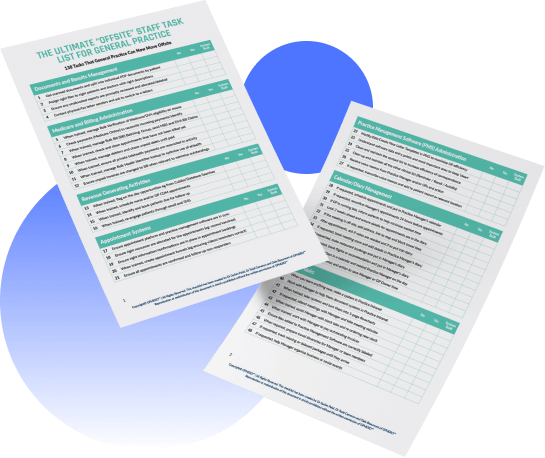
You don’t need to commit to anything to get clear on this. A simple starting point is to write down the tasks your team did last week that didn’t need a clinician or a physical presence. If that list is longer than you expected, that’s your answer to “is there something here worth offloading?”
If you’d like help sorting that list into what could go and what should stay, we’re running a free session on exactly that: Offload 130 Admin Tasks, live on Zoom on Wednesday 28 October at 10am AEDT.
Save your free seat → · Can’t make it live? Register anyway and we’ll send you the recording.
Deciding to get help isn’t a sign the Practice is falling behind. It’s usually the moment a good Practice Manager decides they’ve carried enough alone. You know your Practice better than anyone, and that’s exactly what makes this decision yours to make well.