

If your front desk has felt busier this year than last, you’re not imagining it and it’s not because your team got worse at their jobs. Nationally, bulk-billing rates jumped from 77.1% to 84.1% in a single quarter this year, the biggest jump since the pandemic. More patients are being funnelled toward bulk-billing practices at exactly the moment reception teams everywhere are stretched thinnest. That’s not a discipline problem. It’s a volume problem landing on a system that was never built for it.
Which raises the real question for any Practice Manager watching missed calls climb without a clear cause: is this actually about your team, or is something structural sitting underneath it? Nationally, missed appointments and calls are estimated to cost the health system somewhere between $150–200 million a year not because any one practice is failing, but because almost no practice has a way to see where its own calls are actually going.
Here’s how to tell which one you’re looking at.
Sign 1: you’re busier, but bookings haven’t followed
If call volume feels higher but your booking numbers haven’t moved with it, that gap is worth naming. Busier phones and a fully-answered phone line are two different things. The calls that don’t turn into bookings didn’t vanish – they went somewhere. Usually back to a queue, a hold, or a caller who gave up.
Sign 2: it’s always the same time of day
A call-flow problem tends to repeat at the same points, every day – the ten minutes after opening, the post-lunch rush, the school-run window. If your team can already predict which hours will be worst before they happen, that’s not bad luck. That’s a pattern, and patterns can be fixed. A genuine staffing shortfall usually looks messier and less predictable than that.
Sign 3: patients mention “couldn’t get through,” but your team says they were flat out
Both can be true at once, and that’s exactly the tell. A team can be working at full capacity and still be losing calls, because being busy and being reachable aren’t the same measurement. If you’re hearing this from patients but your team genuinely can’t point to what they’d do differently, the gap usually isn’t effort – it’s visibility.
Sign 4: no one can say how many calls you’re actually missing
Ask most front desks how many calls went unanswered yesterday, and you’ll get an honest shrug. That’s not a knock on the team it’s genuinely hard to track while also running the desk. But it means the conversation about missed calls almost always happens without a real number attached to it, which makes it very easy to misdiagnose as a staffing or attitude problem instead of what it usually is: a flow that’s never been mapped.
Sign 5: your phone tree seems to be “handling” it, but complaints haven’t dropped
A phone tree can route a call. It can’t answer one. If you added a menu system expecting it to ease the load and the complaints kept coming anyway, that’s a sign the tree just moved the wait somewhere quieter it didn’t close the gap.
Why this matters more this year than last
None of these five signs are new. What’s new is the scale. With more patients being pushed toward bulk-billed appointments than at any point since the pandemic, a call-flow gap that was manageable at last year’s volume can become genuinely costly at this year’s. The practices feeling it hardest right now aren’t the ones with worse teams they’re the ones whose call flow was already stretched before the surge arrived.
What to do if you recognise two or more of these
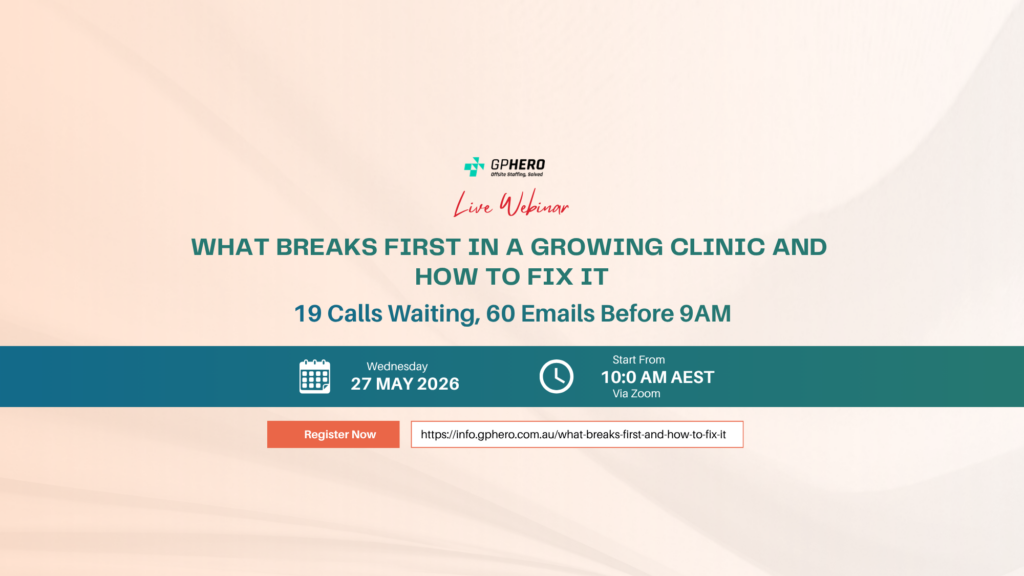
This isn’t a hiring problem, and it isn’t a discipline problem which means the fix isn’t “find better staff” or “try harder.” It’s mapping where your calls are actually going, at the times they’re actually going there, before deciding what needs a person and what a system could absorb instead. We walk through exactly that at Handle 500+ Calls a Day, Without Missing One, free on Zoom, Wednesday 30 September.
Save your free seat → · Wednesday 30 September · 12:00–1:00 PM AEST · Live on Zoom · Can’t make it live? Register anyway and we’ll send you the recording.
A busier front desk isn’t a verdict on your team. It’s a sign worth reading properly and once you know what you’re looking at, it’s a lot more fixable than it feels on a Tuesday morning.