

Ask most Practice Managers how long it takes to fill a front-desk role and they’ll say “a few weeks.” Then they’ll think about the last time they actually did it, and quietly correct themselves.
Because the honest answer is longer. Usually a lot longer. And the gap between what we expect it to take and what it actually takes is where the pressure builds because the whole time, the seat’s still empty and someone’s covering it. Usually you.
Let’s walk the real timeline, start to finish.
The part everyone counts
This is the bit that comes to mind when you picture “hiring someone”:
- Writing and posting the ad — a day or two, if you already know what you’re looking for.
- Waiting for applicants — a week or two before you’ve got enough to compare, longer in a rural or outer-suburban town.
- Screening and shortlisting — reading through people who’ve never set foot in a practice to find the few who have.
- Interviews — booking them around a working week that’s already full.
- Reference checks and the offer — another few days, sometimes more if referees go quiet.
Add that up honestly and you’re already weeks in, and you haven’t hired anyone yet. But this is only the part people count.
The part everyone forgets
Here’s where the timeline quietly doubles.
The notice period. Your best candidate almost always has a current job. Two to four weeks before they can start — and that’s four weeks with the seat still empty, after you thought the hard part was over.
The ramp-up. Day one isn’t relief. It’s the start of training. A new starter has to learn your software, your billing rhythm, your recall process, your patients, your way of doing things. For weeks they’re asking questions, and the person answering them is — again — you. Real capacity, where they’re genuinely taking load off rather than adding it, is often another month or two away.
So the true question was never “how long to hire someone.” It’s “how long until the seat actually stops draining my time.” And that answer, told honestly, is rarely weeks. It’s months.
Why this is the whole problem
None of this means you’re doing it wrong. Local recruitment for General Practice is simply slow by design — every stage has a wait built into it, and you can’t skip them. Post faster, pay more, use an agency: you might shave a little off the front end, but the notice period and the ramp-up don’t care how motivated you are.
This is the point we make in our companion piece — that an empty seat isn’t a hiring problem, it’s a speed problem. When the fastest path available to you takes months, working it harder doesn’t make it quick. It just keeps you covering reception while you wait.
Is there a faster path?
There is, and it’s the reason we built GP Hero.
Instead of recruiting and training someone from scratch, you bring in a support person who’s already trained on how a General Practice runs — the admin, the recalls, the billing, the patient comms — and who slots into your existing systems. No months-long ad cycle. No notice period. No training a beginner from zero. We handle the employment and the day-to-day behind the scenes, so you get working hands without another person to supervise.
The timeline that surprises people most isn’t weeks. It’s days.
See exactly how it works
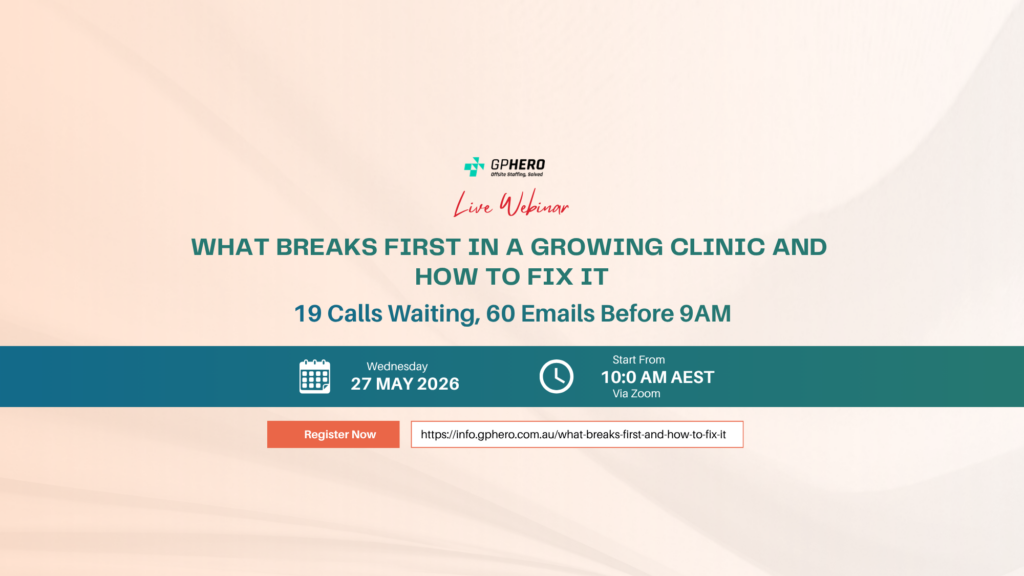
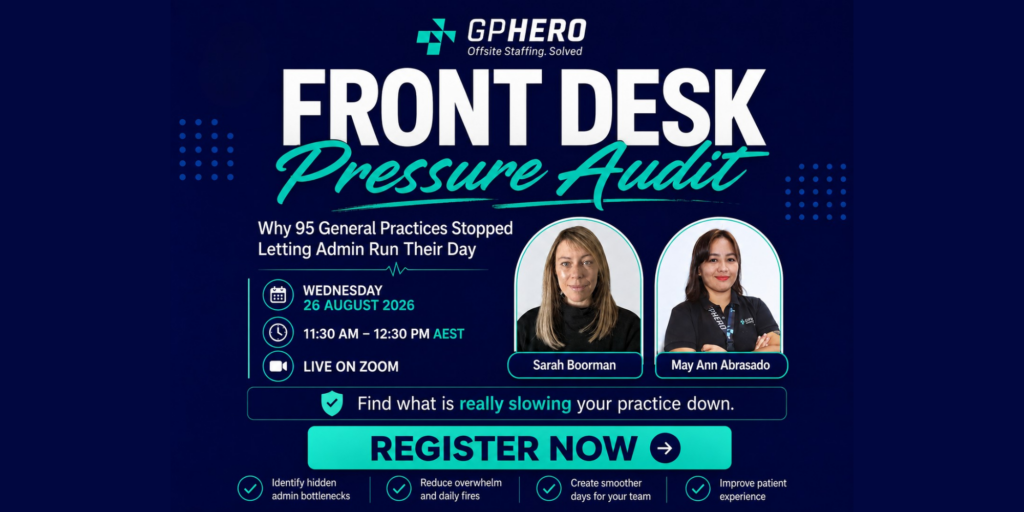
On Wednesday 29 July at 10:00 AM AEST, we’re running a free, one-hour live session that walks the whole thing through, day by day — how you go from an empty seat to someone working inside your systems this week, not next quarter.
If you’ve spent the last few months counting weeks that turned into months, this is the hour that shows you the shorter path. And if you can’t make it live, register anyway — we’ll send you the recording.
You’ve carried the gap long enough. Come and see what filling it fast actually looks like.
Free to attend · Live on Zoom · Recording sent to everyone who registers.
Hosted by Sarah & May — the team behind the offsite staffing model built specifically for Australian General Practice.